Ryan's Method Review - My Experience With Ryan Hogue's Training
Welcome to this Ryan's Method review. After researching and testing his program, my impression is that it is one of the more established print-on-demand and ecommerce training programs available.
Ryan Hogue has been creating content for years, and unlike many newer gurus, he has built a large amount of free educational material alongside his paid courses.
The biggest strength of the program is its step-by-step approach.
Instead of focusing on hype or unrealistic promises, the training appears to concentrate on building multiple print-on-demand income streams across platforms like Amazon Merch, Etsy, Redbubble, and Kindle Direct Publishing.
However, the business models taught inside the program are much more competitive than they were several years ago.
Print-on-demand has become crowded, and success often requires patience, consistency, and large amounts of content rather than quick wins.
People considering the course should understand that buying training alone does not guarantee results.
Building these businesses still takes time, experimentation, and ongoing work.
Pros
Ryan Hogue has years of experience and a large public presence.
Extensive free content is available before purchasing.
Covers multiple print-on-demand platforms.
Training appears focused on long-term business building rather than hype.
Cons
The program is expensive compared to free alternatives.
Print-on-demand is much more competitive in 2026.
Results can take months rather than weeks.
Success depends heavily on consistency and volume.
If you're trying to figure out which online business models are actually worth pursuing long term, I put together a short guide explaining the mistakes I learned to avoid and the things I now pay attention to before investing time or money into anything. You can read it here.
What Is Ryan's Method?
Ryan Hogue created this ecommerce and print-on-demand training platform to teach people how to build online income streams through marketplaces such as Amazon Merch on Demand, Etsy, Redbubble, and Kindle Direct Publishing.
Rather than focusing on a single business model, the training combines several approaches under one umbrella.
Members can learn about print-on-demand, self-publishing, and marketplace-based ecommerce without having to deal with inventory or traditional retail operations.
One thing I noticed while researching the course is that Ryan has been creating content publicly for years.
His YouTube channel contains hundreds of free videos covering many of the same topics, allowing potential students to see his teaching style before deciding whether the paid training makes sense for them.
The overall approach revolves around creating a large number of listings across multiple platforms instead of relying on one product or one source of income.
The idea is that small earnings from individual products can compound over time as more listings are added.
Unlike some programs that focus heavily on fast results, this training appears to emphasize building long-term assets. That doesn't mean success comes easily.
Print-on-demand and marketplace selling have become far more competitive in recent years, and results still depend heavily on consistency, research, and patience.
For people interested in ecommerce but who don't want to manage inventory, shipping, or warehouses, this approach offers an alternative way to participate in online retail.
My Personal Experience With Ryan's Method
After going through the training, one thing I liked immediately was how much information was included.
Instead of focusing on only one platform, the course covered several ways to build print-on-demand and ecommerce income streams.
I also appreciated that Ryan's teaching style was straightforward. The lessons were easy to follow, and I never felt like I was being sold unrealistic expectations.
The overall message seemed to focus on consistency and building assets over time rather than chasing quick results.
What I found most useful was seeing how different platforms could work together.
Instead of depending entirely on one source of income, I liked the idea of spreading products across multiple marketplaces.
At the same time, I quickly realized that this isn't a business model that produces instant results.
Building listings takes time, competition is strong, and patience is necessary. Simply buying the course doesn't automatically create sales.
My experience with the training was positive. I felt that the information was organized well, and I came away with a better understanding of how print-on-demand businesses actually work.
However, success still depended on applying what I learned consistently rather than expecting the course itself to do the work for me.
If you're trying to figure out which online business models are actually worth spending time on, I put together a short guide explaining the mistakes I learned to avoid and the things I now look for before committing to any opportunity.
Who Is Ryan Hogue?
Ryan Hogue is an entrepreneur and content creator who has been teaching ecommerce and print-on-demand strategies for several years.
He is best known for his YouTube channel, where he regularly shares tutorials, updates, and insights related to platforms such as Amazon Merch on Demand, Etsy, Redbubble, and Kindle Direct Publishing.
Unlike many creators who appeared during the recent AI and ecommerce boom, Ryan has built his audience over a much longer period.
This gave me more confidence because I could easily find years of public content instead of relying only on a sales page.
One thing I noticed while going through his material was that his teaching style felt straightforward and practical.
He tends to focus on systems, consistency, and creating large numbers of products rather than promoting unrealistic expectations.
Over the years, he has expanded beyond YouTube by creating paid training programs designed to help people organize everything in one place.
His courses cover multiple business models, allowing students to explore several income streams instead of relying entirely on one platform.
Whether someone agrees with every strategy he teaches or not, Ryan has established himself as one of the more recognizable names in the print-on-demand space.
His long track record and public presence make it easier to evaluate his approach before deciding whether the paid training is worth the investment.
How Does Ryan's Method Work?
After going through the training, I found that the overall system is built around creating products that can be sold across multiple marketplaces instead of relying on a traditional ecommerce store.
The course starts with the basics, explaining how the business models work and which platforms are available.
From there, the training moves into product creation, niche research, keyword selection, and listing optimization.
One thing I liked was that the process wasn't limited to a single platform. I was able to learn about Amazon Merch on Demand, Etsy, Redbubble, Kindle Direct Publishing, and several other opportunities inside the same ecosystem.
The overall strategy focuses heavily on volume. Rather than expecting one product to become a huge success, the idea is to create many listings and allow them to accumulate over time.
Some products may perform better than others, but the long-term goal is to build a growing portfolio of digital assets.
Another thing I noticed while using the training was that consistency mattered much more than speed.
The people who are most likely to benefit from this type of business are those willing to keep creating products over long periods instead of expecting immediate results.
Although the process itself is relatively simple to understand, success still depends on execution, product quality, niche selection, and patience.
What Is Included Inside Ryan's Method?
After going through the training, I found that the biggest advantage was having multiple business models gathered in one place instead of needing to buy separate courses for each platform.
The program includes training for several print-on-demand marketplaces, along with lessons covering product research, keyword selection, listing optimization, and strategies for growing a larger portfolio over time.
I also liked that the material wasn't limited to one source of income. Rather than focusing entirely on Amazon Merch, the training explored additional platforms such as Etsy, Redbubble, and Kindle Direct Publishing.
This made it easier to diversify instead of depending on a single marketplace.
Another thing I appreciated was the amount of supporting resources included alongside the lessons.
Having templates, examples, and walkthroughs helped make the information easier to apply.
Because Ryan has continued updating his business over the years, the training also covers newer opportunities and changes within the print-on-demand space.
That was important to me because many older courses I've tried in the past become outdated quickly.
I felt the biggest value wasn't necessarily any one lesson. It was having everything organized in one place, making it easier to follow a clear path instead of jumping between dozens of YouTube videos and free resources.
How Much Does Ryan's Method Cost?
One of the first things I looked at before trying the training was the price because there are several different packages available.
Instead of offering a single course, Ryan has separated the material into multiple programs.
Individual courses can cost several hundred dollars, while the complete bundle is significantly more expensive and can reach well over a thousand dollars depending on current promotions.
Compared with free YouTube content, the investment is substantial. That was something I had to consider carefully because there is already a huge amount of information available at no cost.
What ultimately convinced me to look deeper wasn't the promise of making money quickly.
It was the convenience of having everything organized in one place instead of trying to piece together information from dozens of different videos.
Another thing I kept in mind was that the course itself isn't the only expense.
Depending on which platforms you focus on, you may also need design tools, keyword research software, or other resources along the way.
I felt that the price made more sense for people who prefer structured training and want all of the information gathered in one location.
People who enjoy learning independently may find that Ryan's free content already provides enough value without purchasing the paid programs.
How Much Can You Realistically Make With Ryan's Method?
This was probably the question I cared about most before getting started.
After going through the training, I quickly realized that print-on-demand is not a business model where most people see results immediately.
Some products may never sell at all, while others can continue generating sales for months or even years.
What I found interesting was that the strategy wasn't built around creating one winning product.
Instead, the focus was on building a large portfolio over time. The idea is that small amounts of income from many products can add up as more listings are added.
That said, I learned very quickly that patience is required. Competition is much higher than it used to be, and simply uploading a handful of designs isn't enough anymore. Consistency played a much bigger role than I originally expected.
My own impression after using the training was that expectations matter. People looking for fast income will probably become disappointed.
On the other hand, those willing to treat it as a long-term project may appreciate the gradual approach.
Ultimately, I don't think anyone can honestly promise specific earnings. Success depends on factors such as niche selection, product quality, consistency, and market competition.
The training can provide direction, but the actual results still come down to execution.
Common Complaints About Ryan's Method
While my overall experience with the training was positive, I also came across some criticisms that are worth mentioning.
The most common complaint I saw was the price. Because there is so much free information available online, some people question whether paying several hundred or even thousands of dollars for structured training makes sense.
Another criticism involves the business model itself rather than the course. Print-on-demand has become much more competitive over the years, and some students become frustrated when they realize that success takes longer than expected.
I also noticed that some people expected fast results. After using the training, I never felt like it promised overnight success, but unrealistic expectations can still lead to disappointment.
Another concern raised by critics is that some of the strategies discussed in older content may become less effective as marketplaces evolve.
Ecommerce platforms change constantly, and methods that worked years ago may not perform the same way today.
Finally, some people simply prefer free YouTube content and feel they don't need a paid course.
Since Ryan already publishes a huge amount of free material, I can understand why some buyers struggle to justify the additional investment.
From my perspective, most of the complaints I found were not unique to this training.
They are common concerns that exist throughout the entire print-on-demand industry.
Ryan's Method vs Free YouTube Content
One question I kept asking myself while going through the training was whether the paid version actually offered enough value compared to the huge amount of free content already available online.
Ryan himself has published hundreds of YouTube videos over the years, and I had already learned quite a bit just by watching those.
There are also other creators covering similar topics for free, which makes this a fair question for anyone considering the investment.
After using the program, I felt that the biggest difference wasn't necessarily access to secret strategies. Instead, the value came from having everything organized in one place.
Rather than jumping between dozens of videos, I could follow a more structured path and move from one topic to the next without wondering what to learn next.
I also found it useful having multiple business models collected under one membership.
That saved me from trying to piece together information from several different sources.
That said, I honestly think some people may not need the paid training at all.
If you're highly self-motivated, enjoy researching things independently, and don't mind spending extra time gathering information yourself, Ryan's free content may already be enough.
For me, the paid training felt more like a shortcut to organization rather than access to something completely unavailable elsewhere.
Who Is Ryan's Method For?
After using the training, I felt that it was best suited for people who are interested in ecommerce but don't want to deal with inventory, shipping products, or managing a traditional online store.
I think beginners will probably benefit the most because the lessons start with the fundamentals and gradually move into more advanced topics.
Having everything organized in one place made the learning process easier compared to trying to piece together information from dozens of different sources.
I also think the program makes sense for people who enjoy building long-term projects.
The overall strategy relies heavily on consistency and creating large numbers of listings over time rather than chasing quick results.
Another group that may find value here are people looking to diversify their income streams.
Since the training covers multiple marketplaces, I liked that I wasn't forced to depend entirely on one platform.
At the same time, I think patience is essential. People who expect immediate income or who become discouraged quickly may struggle with this type of business model.
I came away feeling that this training is better suited for people who are willing to put in consistent effort and view ecommerce as a long-term business rather than a short-term opportunity.
Who Should Avoid Ryan's Method?
Although I had a positive experience with the training overall, I don't think it's the right fit for everyone.
If you're looking for fast results or hoping to replace your income within a few weeks, you'll probably end up disappointed.
Print-on-demand businesses usually take time to grow, and there are no guarantees that your first products will sell.
I also wouldn't recommend this type of business to people who dislike repetitive work.
After using the training, I realized that success often comes down to consistently creating listings, researching niches, and continuing to upload products over long periods.
Another group that may not need the course are people who enjoy learning independently.
Since Ryan publishes a huge amount of free content, highly motivated individuals may be able to learn a lot without paying for the full program.
I also think people with very limited budgets should think carefully before investing.
While print-on-demand doesn't require inventory, there are still software tools and other expenses that can add up over time.
I believe this training works best for patient people who enjoy building long-term assets. Those looking for immediate income or completely passive results may find other opportunities more suitable.
Ryan's Method Pros and Cons
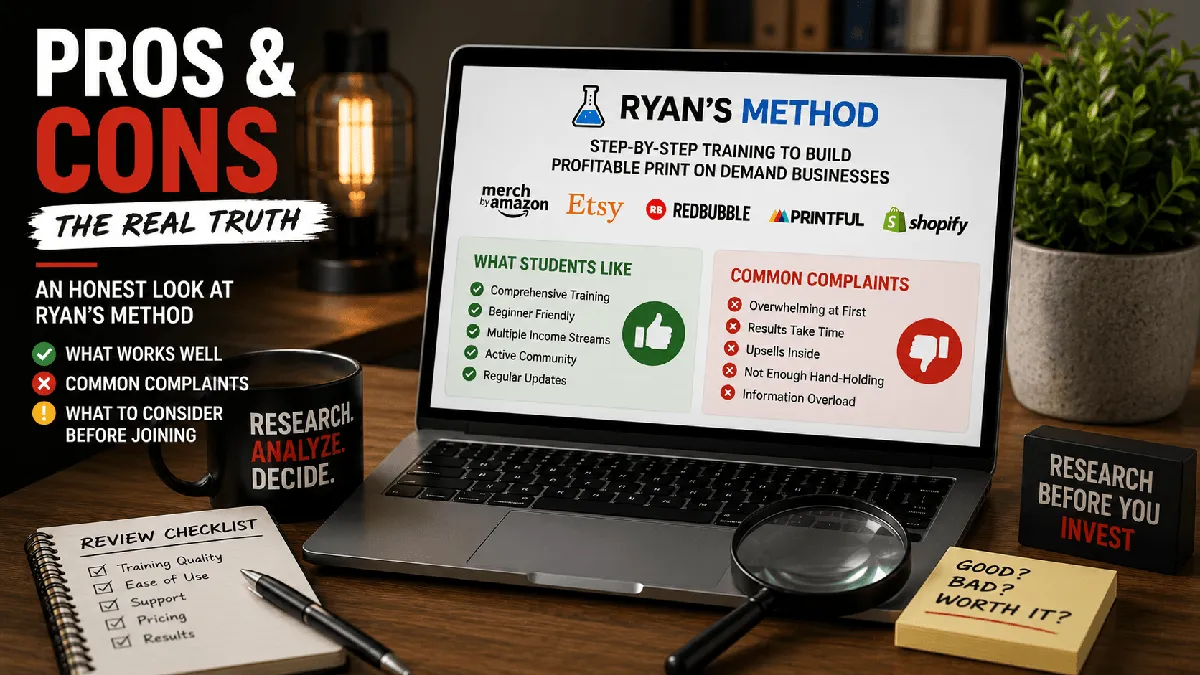
One of the biggest strengths I noticed after using the training was how much information was gathered in one place.
Instead of buying separate courses or trying to connect information from dozens of videos, I appreciated having everything organized inside a single platform.
I also liked Ryan's teaching style. The lessons felt straightforward and focused more on practical implementation than on hype.
I never felt pressured by unrealistic promises, which is something I pay close attention to when reviewing programs.
Another advantage was the ability to learn multiple business models. Covering Amazon Merch, Etsy, Redbubble, and other marketplaces gave me more flexibility and reduced the feeling of depending entirely on one source of income.
On the downside, I think the biggest obstacle for many people will be the price.
Since Ryan already provides a large amount of free content, some buyers may struggle to justify the investment.
I also learned that print-on-demand is far more competitive than many beginners expect.
Uploading a few designs and waiting for passive income simply isn't realistic anymore. Consistency and patience matter much more than I originally thought.
Finally, I don't think this business model is ideal for people looking for immediate results.
Building a portfolio takes time, and success often happens gradually rather than all at once.
Final Verdict
After going through Ryan's Method, I came away with a positive impression overall.
I felt that the training delivered what it claimed to provide, and I appreciated that the focus was on building long-term assets rather than promoting unrealistic expectations.
What I liked most was having multiple business models gathered in one place. Instead of trying to learn Amazon Merch, Etsy, Redbubble, and other platforms separately, I found it convenient to follow one system that covered everything together.
At the same time, I don't think this is a course that automatically guarantees success.
Print-on-demand has become much more competitive, and results still depend heavily on consistency, product quality, and patience.
I also understand why some people hesitate because of the price. Since Ryan provides so much free content on YouTube, some buyers may decide they can learn enough without purchasing the paid training.
I think Ryan's Method is best suited for people who want organized training and are willing to approach ecommerce as a long-term project.
Those expecting fast income or effortless results will probably end up disappointed.
The biggest takeaway for me was that the program felt more like a roadmap than a shortcut.
The information can help point you in the right direction, but the work still has to come from you.
If you're trying to figure out which online business models are actually worth building long term, I put together a short guide explaining the mistakes I learned to avoid and the things I now pay attention to before investing time or money into anything.